Wednesday, February 6, 2013

Malabar:Christian Memorials- A new book on Malabar


Book on European graves in
Malabar released

 Kannur, Feb 6:

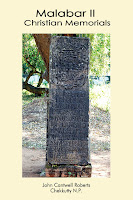
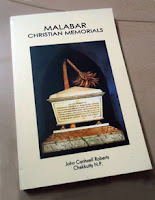
Malabar: Christian Memorials 1737-1990, a book on European gravestones and church memorials in the Malabar towns of Kannur, Thalassery and Mahe has been released at the International Book Fair in New Delhi. The book, researched and written by Dr John C. Roberts, a social anthropologist who worked at Oxford and Columbia universities, and N P Chekkutty, a senior journalist in Calicut, has details on the Portuguese, Dutch, French and English gravestones in the region. The book also has a complete list of Europeans buried in various cemeteries in these towns during the past two centuries,  based on the burial registers maintained in various churches.

The authors said research work on the book was launched in September 2010 and data was gathered from the extant gravestones in cemeteries, burial registers in churches, and quarterly returns on births and deaths maintained by the French and English governments on their citizens, kept in the British Museum and the French National Archives.

The book covers burials at the St Johns Anglican Church and Holy Trinity RC Church in Kannur, the St John’s Anglican Church and the Holy Rosary RC Church at Thalassery, and the St Theresa’s Church and cemetery at Mahe. The burials at the German Basel Mission cemeteries at Kannur and Thalassery are also recorded. The book has details on the European regiments and native troops stationed at the Cannanore Cantonment and details on deaths in armed forces.

The authors said the book gives a comprehensive picture of the health hazards faced by the Europeans in the colonial towns in 19th century, as most of the entries have details on the cause of death.

The 272- page book, with two maps and a large number of photographs, is published by the South India Research Associates (SIRA), a voluntary network of researchers and scholars, registered in New York. 

Monday, October 22, 2012

Culture and History? Go to Dogs...


Here is a note submitted to the Cultural Affairs department of Kerala  government with regard to restoration of some 16th-17th  century Portuguese gravestones, now dumped in a government museum  in Trissur. It was submitted to Mr K C Joseph,  Cultural  Minister, on April 17, 2012 and so far no action has been taken, though the government  had promised to do so.

WE the undersigned, Dr John Cantwell Roberts of New York and N P Chekkutty, Calicut, have been working on a project for the proper recording and analysis of the European gravestones and cemeteries in the erstwhile British Malabar and Nilgiri districts for the past two years.  Dr John C Roberts is a retired social anthropologist who has served in various centers of learning including the universities of Oxford  and  Columbia and is the author of scholarly  articles and books like the Early Cantwells in Ireland, a major work on medieval European prosopography. N P Chekkutty has worked in India for almost three decades as a journalist. Two books —Malabar:  The Christian Burials and Memorials in Kannur,Thalassery & Mahe 1723-1950 and The Nilgiris: Christian Burials and Memorials in Gudalur, Ootacamund, Wellington, Coonoor & Kotagiri 1822-2000, will be published by the British Association for Cemeteries  in South Asia (BACSA), London, later this year, as part of our work.  We are now working on the European burials in the rest of old Malabar, comprising areas from Calicut to Angengo in the south.

The present work has academic as well as economic aspects:  As we try to restore the genealogy of the families and individuals buried here, we are also providing a handbook for potential tourists who are looking for details on the final resting place of their ancestors who died in India in the centuries past.   There are tens of thousands of such people buried in the Malabar coast, who came from all parts of Europe, dating back to early 16th century. Some of these monuments are of great historical value and ought to be preserved for the benefit of future studies.

In this connection, we would like to bring your attention to half a dozen gravestones of Portuguese origin, removed by the authorities from an old graveyard near Kodungallur and now stored in the Government Murals Museum, at Chembukakvu, Trichur.  We are sorry t o say that most of these gravestones of some historical significance are dumped one over the other in the courtyard of the museum and are handled in a most deplorable manner. Of the six gravestones we could identify with the help of Prof. Rafael Moreira of the New University of Lisbon, Portugal, only one is in a good condition while all others are broken into pieces, covered with mud and slime making them quite illegible, thanks to insensitive and rough handling as they were transported from place to place after being pulled out of their original resting place. 

Of the six gravestones, we could properly identify the one that belonged to Felipe Perestrelo, who was vicar and school teacher in the region in late 16th century.  His life and family connections are most exciting and evoke historical memories of the period, as he came from a noble Italian family that was related to the Portuguese crown as well as to Christopher Columbus, the great navigator who charted a new route to the Americas in 1492 opening up a new chapter in world history. Other interesting finds in this collection, though broken, include the coat of arms of the Costa family, the burial stone of a navigator who sports the intriguing insignia of the skull and cross bones, a late 17th century symbol that denoted sea pirates.  This must be one of the earliest such symbols ever used and hence of great value in the study of the history of navigation and piracy.

We earnestly call upon the Government of Kerala to take notice of the manner in which these historical relics are handled making them almost inaccessible to scholars and visitors. These stones need to be properly cleaned and mounted, using concrete base fixed with iron bars which will hold the broken pieces  in a proper shape so that visitors and scholars can inspect them at their leisure. You can see that it would cost next to nothing to the exchequer while it would attract large numbers of new visitors to the state.

We do hope the government will take steps for their proper upkeep and we assure every help from scholarly community in India and outside for the restoration of these gravestones.

With sincere thanks,
Dr John Cantwell Roberts, New York
N P Chekkutty, Calicut

Wednesday, October 10, 2012

Bab-al Bahrain

THE ships came unannounced
dancing on the waves big and small;
laden with wares rich and rare
they entered the souk
through the arched gateway;
beneath its high dome
a world rich and glamorous.

He was weird and with a beard,
she laughed at him for his looks;
she hid beyond the Venetian blinds
of Awal; around him shops
glittered, and bright windows
glowed with gold and pearls.

In the desert and the scorching sun
love struck him like a thunderbolt;
a lonely wanderer all his life
it struck him mad; it made him blind.

Where did I hear the playful laughter
that cuts like a razor sharp?
Where did I hear the distant sigh
that moves the mountains high?
From Jishanmal's narrow streets
to the wide expanse of golden
sand on the way to the Tree of Life
he prays for a fleeting glimpse
of the divine form, etched in soul.

At the high-domed grand mosque
a prayer goes up in heavens,
Ya Allah, show me the way
to the divine presence.
To the one who prayed on her
knees, for the beloved
who wandered far and wide.

For whom the battles raged
in mystic Dilmun days?
For whom the pearls longed
in their sleepy oyster homes?
For whom the Barbar temple
offered beasts and birds?

She remains hidden in the shrouds
of history; her golden neck unadorned,
her lovely limbs un-massaged;
her lazy locks unfastened;
the sheets in her bed longing for
the day her man will come with
a sweet and mesmerizing smile.

Wafa Manama, 03.10.2012.

(Dedicated to Dr Maria Bernadette Gomes, who told me about the romantic charm of Bahrain past, opening my eyes to a life beyond the malls and marts in the deserts.) 

Friday, August 17, 2012

T Venugopalan: A Pioneer in Media Professionalism

“ONE of the toughest days in my career,” T Venugopalan, veteran Malayalam journalist who died in Calicut on August 3, 20012, at age 82, used to tell all those who cared to listen to him in his innumerable sessions all over Kerala, explaining the challenges o f making a good newspaper front page, “ was the day Indira Gandhi was shot dead.” Most of his younger students could not imagine how daunting the task for the veteran, then at the pinnacle of his career, the presiding deity at the central desk of Kerala’s most respected nationalist daily, Mmathrubhumi, when the tragic incident took place on the last day of October in 1984. It shocked the nation, something almost similar to the assassination of the Mahatma over four decades earlier. The incident posed serious professional challenges before any media-person who had to convey the shock, the dramatic nature of unfolding events and its immense significance to a grieving nation to the discerning readers used to the laid back approach of the print medium that was facing big threats from a nascent visual media. And for Venugopalan, it was not just another news development that was earth-shaking: It was indeed a personal loss and a deeply traumatic experience because he was born and brought up in the same nationalist tradition that gave birth to a leader like Indira Gandhi. His father was close to the nationalist movement and that is why he came to Mathrubhumi, the newspaper that came into existence as a mouthpiece for the Indian National Congress In Kerala in 1923, at the tender age of 22 in 1952, hand chosen by V M Nair, then its managing director. He had just completed his BA degree from Kerala Varma College, Trissur, a centre of learning with strong literary ambiance, when he was whisked to the desk of the tradition-bound newspaper which was struggling to come to terms with its own transition to a commercial product in a new and vibrant industry, from its original incarnation as a nationalist mouthpiece. It was not an easy time for him or anyone else to join the profession. The old pattern of well known and idealist politicians doubling up as agents and reporters and editors, who would disappear to the next public meeting exactly at the moment when the deadline approaches for the next day’s edition, leaving all the troubles and responsibilities to the young and inexperienced hacks back at the desk, was still prevalent and Mathrubhumi had a big crop of such veterans who looked down upon the wannabe crowd of younger professionals who had different ideas about media work. For those who belonged to the old school, age-old rules were sacrosanct and no experiments in the style of writing, page layout, or design were to be tolerated. All such talks about professionalism and media’s role as an industry were anathema and it was in such a context that a young professional like Venugopalan made concerted attempts to bring in new experiments and new ideas to all departments of newspaper profession like reporting, editing, design and makeup. “No rule is immune to changes,” he used to say, “if you could convince your readers that they are good.” That is what he did that day when Indira Gandhi died. He simply dumped the old style of as much information on the front page, and instead made a page that conveyed the image of a nation in shock, with sparse text and stark and dramatic graphics—a precursor to the graphics-rich newspaper design that became the norm a decade or so later. A tribute to the man who was bold enough to experiment beyond his times, this particular edition of the paper is now in display at the Nehru Memorial Museum& Library in Delhi, in a collection on the historic moments in the young nation’s life. Venugopalan was one of the most prominent among the first generation of post-Independence Malayalam journalists, who redrew the rules of the profession and made them more in tune with changing times. He thought professionalism was the key to the success of the new industry, and along with the other veterans of the generation like Thomas Jacob of Malayala Manorama, P Aravindakshan of Indian Express, N V Pylee of Express (Malayalam) and N N Satyavratan of Mathrubhumi, he endeavoured to bring in professionalism across the length and breadth of the newspaper profession in Malayalam, with training session for local reporters and staff members in other newspapers, most of them small and medium units which dominated the media industry back then. He insisted on a simple: Make things simple and easy to communicate, for your readers are simple folks. He was general secretary of the Kerala Union of Working Journalist s (KUWJ) for three terms in its infancy, and in this capacity developed a media training programme called Newscraft for media professionals in the State bringing in well known name s in Indian journalism and world media including from Thomson Foundation in London for its workshops conducted all over Kerala. It was from the experiences gained from these sessions of Newscraft that the Government of Kerala was persuaded to set up the Kerala Prèss Academy, which became the nodal agency for media training in the State late on. Venugopalan had around 50 years of experience in Malayalam journalism at the time when he took voluntary retirement from Mathrubhumi as deputy editor in 1988, following a tiff with the management. He then became the most celebrated media expert and consultant for smaller newspapers and start-up television channels that sprung up n the nineties and even later. In the decade or so when was active after retirement, before illness forced him to take a backseat, he had served in various newspapers like Madhyamam, Mangalam, Express, etc, and also anchored a programme on media at Asianet which was considered a path-breaking one in such genre in Malayalam television. As a younger professional, I was associated with him from late nineties, when he took over as the first director of the Institute of Communication & Journalism (ICJ), one of the first media training institutions in Malabar region, s et up by the Calicut Press Club in 2000 with government assistance for infrastructure. As president of the Press Club and chairman of the governing committee of the ICJ, I had worked closely with him in those initial years, when he tirelessly worked to develop a state off the art curriculum for the one-year post-graduate diploma course offered there, with special emphasis on new and emerging areas of media activity like television, new media, etc. We were also able to bring out a journal on media and society, Media Focus, which carried articles and analysis from a number of Indian and international scholars and professionals in the two years of its existence. Venugppalan proved to be a very sincere and committed senior advisor to most of the new media ventures that came up in the late nineties and early 2000s in Kerala. I was personally involved in at least two such initiatives, seeking and receiving his help and advice in matters like recruitment, training, etc—first at Kairali TV News which started telecast at Cochin in August 2000 and then again at Thejas daily, launched from Calicut in January 2006. He was a modest man, always accessible, and very pleasant. A chain smoker, he kept the Scissors brand of cigarette stuck tight in his fingers almost always-- which finally spurred his end with nicotine poisoning in his systems. With child-like pleasure and eagerness, he took part in all kinds of activities in his office along with the most junior colleagues, whether it is playing games, pulling the legs of a colleague or writing instant poetry to drive away the drudgery of the work at late night shifts. He had another, serious pursuit in his private moments: As a scholar and researcher whose contributions might remain for a long time. He spent more than 12 years researching the life and works of Swadeshab himani k Ramakrishna Pillai, Kerala’s most celebrated journalist and editor who was banished from his native Travancore in 1910, writing his biography as well as editing and publishing all his works and editorials in a series of volumes. He was a self effacing man, who avoided the limelight and kept off from public platforms except at media class rooms. The Government of Kerala honoured him in 2011 with the first Swadeshambhimani- Kesari Award, instituted in memory of the two legendary editors in Malayalam, for his life long contributions to Malayalam media and journalism.

Monday, September 12, 2011

Secret Life of a Prince in Indian Garrisons

BURMA's last monarch, King Thibaw and his consort, Queen Supayalat, spent 31 years as prisoners in a hill-top bungalow at Ratnagiri, in Maharashtra, after his country fell to British troops in 1885. The last of the Konbaung dynasty, Thibaw and the royal family lived in utter penury. The Brits who plundered his palaces and coffers, divested him of the gems and rubies and gold, gave him a pittance for his subsistence. Amitav Ghosh, in his modern classic, The Glass Palace, describes how the Queen enforced strict economy at the household, and the princesses huddled around a single oil lamp to do homework.
But the king was, in a way, lucky. His sad life had become an international scandal. The British lost face, though they kept the money. But they successfully maintained that Thibaw was the only state prisoner they had, as the queen had helpfully murdered all members of the royal family in a ruthless operation to finish off rivals.
But this was falsehood. They had at least one more prisoner from Burma’s royal family, Prince Moung Lat, who remained a state prisoner for 54 years in Indian garrisons. The administration, however, never accepted he was in their custody. Yet, evidence of his life in Indian garrisons remains. In Cannanore, an old cantonment town in north Kerala, a brief entry in the burial register at the 19th century English Church says: Egbert Alexander Granville James, died and buried on 19th August 1887, son of Prince Moung Lat, Burmese state prisoner.

Prince Moung Lat escaped the mass murders at royal family because at the accession of Thibaw to throne, following death of King Mindon in October 1878, he was in British custody. The Prince had been leading a guerrilla war against the British and at the time of mass murders, he was already serving out his indefinite term in India.

The Prince and King Thibaw were cousins and both had an equal claim to throne. Moung Lat was born in 1852, son of Hliene Mein, king of Burma, who had succeeded King Tharawaddy. When he was one year old, his father was assassinated by Mindon, his younger brother, who usurped the throne in 1853. King Mindon had a long reign. He is considered the wisest among Burma’s rulers though he was known to be mentally unstable because of debilities due to generations of inbreeding in royal family. Prince Moung Lat was expected to succeed Mindon, as the Burmese dynasties did not follow strict primogeniture in succession and the fact that Mindon had a low opinion of his son Thibaw. ”If Thibaw ever came to the throne,“ he once remarked, “then Burma will pass into the hands of foreigners.”

There are two versions about the childhood of the Prince. According to one, King Mindon allowed the child to live in the palace. Some speculated that he was to be murdered in due course while others said Mindon, in guilt, would appoint him his heir.

Another version is that after the assassination of her husband, the king, his mother Me Eepu Kempoo of Hanthawadi, smuggled the child out of the palace, and secretly brought him up at Pangoon-Yah, a remote part of the country. But at some point, the young prince had returned to the palace. When his mother died in 1860, the Prince was eight years old and was living in the royal palace at Mandalay with a private tutor.

Those were tumultuous days: there were troubles everywhere. Lower Burma was virtually under British rule. A group of princes rebelled in 1866, and the Brits were rumoured to be behind it. They wanted to topple Mindon and install someone more inclined to their interests. As the rebellion failed, many princes fled Mandalay. Colonel Edward Sladen, British political agent in the court, helped Moung Lat to go into hiding in Shan hills in the guise of a Buddhist monk. While a fugitive, the Prince realized the British were behind the 1866 rebellion, and they wanted to capture what remained of the Burma kingdom. Convinced of the need to drive them out, he gathered an army and launched guerrilla warfare, based in the jungles of Toungoo, then under British control.

He was barely 20, and inexperienced in jungle warfare. However, he was known as a terror and was high on the Wanted List. Then Cupid struck: The Prince fell in love with a girl he met during his wanderings in the forests. In the book, The Lord of Celestial Elephant, a biography of the Prince, his grand-daughter Elaine Halton refers to his secret love for this Burmese village girl. He wanted to marry her, but only after the war. Her parents wanted to get her married soon and the Prince, with regrets, wished her well. He even waylaid a cart going through the jungle path with a load of furniture. He took two of the best pieces and sent them to her as wedding gift.

This phase of his life as a fugitive and fighter came to an end when he was arrested in 1873. He was transported to Aden, a British possession, but he refused to live there and even threatened to commit suicide. ”No decent bird would tolerate to live in Aden,” he told his captors.

Soon he was transferred to Cannanore. He arrived in a steamer via Mangalore. The Prince was only 23 when he arrived in the town in 1875. Captain R W Sheffield was in charge of his custody in the cantonment. It was light custody in a remote town, far away from home: he had to report his presence every evening before retirement. He was assigned a house with a garden, and his gates were guarded by 25th and 9th Madras Native Infantry. He spent his time gardening; his garden was famous for its variety of flowers and vegetables.

Then struck Cupid again: Across the road lived an Australian widow and her two daughters. Henrietta was the widow of Thomas William Godfrey, a merchant who involved in trade between Australia and India. He had died at sea over a decade before, while the elder daughter Eveline was four years of age. The couple had four children and two of them-- a boy and a girl--had died in infancy, while they were living at Black Town in Madras. Thomas Godfrey was 11 years senior to Henrietta. They were married on 16 October 1850, at Madras. His father Colonel Samuel Godfrey was in British Army, a person notorious for his violent temper. He was reputed to have had carved off the head of his Indian butler at a dinner party for failing to deliver a dish he was looking forward to.

The Prince fell in love with Eveline, then sixteen. He made several attempts to talk to her at the beach where they went occasionally for exercises. But the girl said she could talk to him only if her mother permitted.

Mrs Godfrey led a very retired life, and she entertained few visitors. She had been in Cannanore for a long time, bringing up her children after the death of her husband, supporting herself with private tuition. She was unusual in this, as English women in that era did not normally have independent careers. She had many children under her care, and with a government grant, she opened a Montessori School in the town, considered the first Church of England school in western India.

The Prince expressed his wish to marry her daughter, and the lady had no serious objections but she raised two points: She could not allow the marriage without permission of the Government as he was a state prisoner; and secondly, there was a problem of religion--he was Buddhist and they were Protestant Christians. The Prince agreed to get permission from the authorities and also to convert to Protestant Christian Faith.

What made the English lady accept a declared enemy of the state, who was described as a “savage given to very violent temper,” as her son-in-law? Evidently, they got on very well from their first meeting. When Captain Sheffield described him as a savage she laughed and said, “He does not look one!” Captain Sheffield also told her about his activities as rebel leader in Burma, asserting that had the British not captured him at the time there would have been a serious outbreak, as almost the entire lower Burma was in his hands.

King Mindon in Mandalay was informed about the intentions of his nephew the Prince, and having received his consent, the Government instructed Bishop Frederick Gell in Madras to take steps for his formal acceptance into the Anglican Church. Rev John Smithwhite, chaplain at St John’s Church, Cannanore, was asked to give the Prince instructions in the Bible, so that he could be ready to receive the sacrament. The formal ceremony took place in the church on 31st March 1878 with Rev. Smithwhite performing the Holy Communion in the presence of witnesses, R W Sheffield and Patrick Fennel, both officers in the army. The Prince took a new name, John William Moung Lat, a name selected by Eveline.

The wedding took place on 29th April 1878, at the same church, a glittering function for the small town. There was full military regalia, the entire town was in attendance and it was declared a holiday for the cantonment. The Prince wanted to wear the traditional Burmese royal dress, but was not allowed and had to do with the western style suit.

The couple spent ten years in Cannanore and they had three children there: Eunice Augusta, Rupert Alexander George, and Egbert Alexander Granville. Egbert, born on 13th August 1887, died six days later.
The Prince had attacks of asthma and on medical advice, he was moved to Bangalore, a town with a more agreeable climate. They spent the next 18 years there. They had five more children and the family grew. In 1906, he was sent to Madras. His health continued to deteriorate and he was, once again, shifted to Bellary. His life was difficult, with a large family to support and a meager income. While in Madras, he petitioned the Government for an increase in his allowance. The request was promptly turned down. Furious about the ill-treatment of the Prince by the Government, whose forces took away his country and plundered its coffers, Eveline wrote about their plight directly to Queen Alexandra, the Empress of India. The queen sent her money from her own personal resources for the children’s education.

The Prince’s financial troubles had been mounting ever since moving to Bangalore and on one occasion he was forced to approach a civil court for some respite from creditors. An item in the New Zealand newspaper, Nelson Evening Mail, in 1892, in its section “Interesting Gleanings”, says: Not all the petty princes in India are rolling in wealth, for a certain Prince Moung Lat recently applied to the civil judge at Bangalore for permission to pay into court five rupees per mensem towards a judgment debt of 280 rupees. The prince explained that his government allowance was not sufficient to enable him to maintain his wife and family, much less to meet his liabilities. This plea had no effect, for he was advised to reduce his expenditure and pay his debt in full.

The cruel irony did not stop there: In 1927, when the Prince was 75 and had spent over half a century as a prisoner, came Colonel Lloyd Jr., son of the officer who had captured him in 1873, to visit. When the visit was announced, it was expected to be an occasion for a late apology on the part of the Government, but what the young officer told him was that the Government never paid his father the bounty for the arrest of the rebel he was due! Was he asking the Prince to pay for his own arrest? No one knows.

Towards the end of 1927, the Government decided to release the Prince; by then he had spent 54 years as prisoner. He arrived in Rangoon on 28th January 1928 with his family, to a country he had left as a 21-year-old, and settled down to a new life at Lynne, in Insein, until his death eight years later, on 20th January 1936. He was buried at Kemendine Cemetery in Insein.

The family once again, had to return to India: as refugees when the World War broke out. They lived in Madras where Eveline Moung Lat, life partner of the Prince, died on 8th January 1945. She was buried at St Thomas Mount Cemetery, Madras.

(My thanks to Dr. John Cantwell Roberts, social anthropologist in New York, for his comments and research support.)

A version of this article is published in Tehelka weekly, issue dated September 17, 2011.

Tuesday, December 28, 2010

Loner’s Battle Against Slavery: Thomas Hervey Baber and Slavery in Malabar

Looking back at a single person’s historic battle against the practice of slavery in Malabar on the occasion of the 200th anniversary of the release of slaves found in an English plantation in 1811.


IN the Heart of Darkness, Joseph Conrad describes a moment when the mist lifts unexpectedly, revealing a view of the mysterious surrounds: A momentary revelation of the interior of a Dark Continent, converted into an area of darkness by the marauding forces of Imperialism.

In Malabar, an area which had come under European powers much before Africa surrendered itself to the builders of Empire, such a momentary flash of lightning that revealed the miserable plight of the natives after the arrival of these civilizing forces came exactly 200 years ago, when a young and energetic East India Company officer conducted a search on the premises of a European planter to discover a large number of kidnapped people, forced into slavery. The incident of search on the premises of a European, discovery and the eventual release of slaves despite heavy odds, was one among a series of developments that finally led to the formal ban on slavery in British India three decades later, in 1843.

Slavery was widely practised in Malabar even before the British East India Company took power there in 1792; it was mainly in the form of agrestic bondage, with slave castes attached to the agricultural lands for generations being bought and sold along with the lands. The Indian Law Commissioners in their report on slavery in 1841 noted that castes like Cherumas [slave castes in Malabar] were treated as “absolute property; they are part of the livestock on an estate.” Traditional Hindu and Mohammedan laws had both accepted it, and the EIC’s own fledgling legal system refused to meddle with it, accepting the practice as normal and legitimate. But in the case of Europeans and especially British citizens, the laws were definitely in a grey zone: Most of them owned slaves and used them in their domestic employ, but trading in slaves and forcing people into slavery were treated as criminal offence. The order passed in 1793, by Jonathan Duncan, then Commissioner for the Bombay province, did not prohibit sale of slaves within the province, but disallowed “the practice of shipping kidnapped and other natives as slaves.” The early English approach to slavery is explained in an observation made by Sir William James, chief justice in Calcutta, in 1785. He said, ”It is needless to expatiate on the law (if it be law) of private slavery; but I make no scruple to declare my own opinion, that absolute unconditional slavery, by which one human creature becomes the property of another, like a horse or an ox, is happily unknown to the laws of England, and that no human law could give it a just sanction; yet, though I hate the word, the continuance of it, properly explained, can produce little mischief.”

Though the slaves in Malabar were generally attached to agricultural lands and were employed as agrestic labour, buying and selling of slaves and massive shipping of them for sale outside the province were quite common. Arab ships operating from Muscat and other islands in the Persian Gulf, and many adventurous sailors of European origin operating in the twilight zones of law and anarchy, carried out this lucrative business and various ports in the subcontinent were known to be hubs of such illegal activities. In the Malabar coast, the French-controlled Mahe was known to be a major base for such operations.

Post -1792, Malabar was going through a period of disturbances mainly because of the challenges posed by rebels like Pazhassi Rajah, which continued for more than a decade.The rebels were often in control of the routes that connected the spice-producing Wayanad hill region with coastal towns, making it difficult for the East India Company to procure hill produces like pepper, cinnamon and other spices for export to Europe. In spite of an EIC monopoly on spices trade, a huge network of shady traders and dealers had sprung up, a black market for contraband wares developed, and many EIC officials were making exorbitant amounts in such deals working in cahoots with local traders who operated these networks.

It was then an idea was mooted with the presidency’s rulers in Bombay (Malabar was under Bombay presidency till1800) by a private trader in Mahe called Murdoch Brown (1750-1828) who suggested development of a plantation to cultivate spices in an area closer to the coastal town of Thalassery. In 1797, Duncan, by then governor of Bombay, agreed to the proposal and a 2000-acre plantation was decided to be set up at Anjarakkandy, with Murdoch Brown appointed as overseer of the project. Later, the company transferred ownership of the estate to Brown on a 99-year lease agreement executed in 1802. This gave him the unique distinction of being the first English landholder in India and its first planter.

Brown was a very industrious and colourful character, who was born in Edinburgh in Scotland. He travelled to Lisbon as a young man and from there reached Calicut in 1775 as a consul for Empress Maria Theresa of Austria; served various European powers, then in constant conflict in the Indian Ocean region, and eventually became one of the most influential persons on the western coast of India. Duncan, with whom he had cultivated a close relationship, described him in 1792 as the most considerable of any British subject on that side of India.

But unlike Duncan, others in EIC service had different, and not that flattering, opinions on Brown. When Brown was appointed by Duncan as Malabar interpreter to the Commissioners, Walter Ewer, another senior officer, wrote directly to Henry Dundas, company chairman in London, in 1796: “He is said to be & really appears to be, a Scotsman... [though] he has lived in Mahe as a Dane, & an Austrian, & finished his career of countries, by defending the place in arms, as a Frenchman, in which situation he was taken; let him chuse (sic) his country; being found in arms, he is certainly a prisoner of war; it’s said he was concerned in the war before last, with some merchants of Bombay, in supplying the enemy [Tipu Sultan] with provisions & stores....”

But neither criticisms nor adversities affected the fortunes of Murdoch Brown: He is said to have lost 11 ships, East Indiamen, of 1000 tons or more in the war with France; and later in 1803, in an attack on his plantation by the Coteote [Kuttiadi] rebels, all his buildings and nearly all the productive vines and coffee plants were destroyed. In those days, the plantation was a constant target of rebel attack and Francis Buchanan, who visited Malabar in January 1801, writes in his Travels:” The plantation has of late been much molested by the Nairs, and the eastern part of it has fallen into their hands; so that for the protection of what remains, it has been necessary to station a European Officer, with a company of Sepoys, at Mr Brown’s house. The Nairs are so bold, that at night they frequently fire into Mr Brown’s dwelling: and the last officer stationed there was lately shot dead, as he was walking in front of the house.”

Brown was a highly innovative planter, experimenting with a variety of plants brought from various parts of the world and introducing commercial plantation of many items like pepper, coffee, cinnamon, cotton, etc, in those early days which involved many years of trial-and-error experiments. In a letter published in Asiatic Journal in 1844, his son F C Brown, who inherited the plantation, recalls that “coffee, originally termed Malabar coffee, was produced from seeds which my father obtained from Arabia, nearly half a century ago, years before Java coffee was extensively known in Europe as an article of import.”

Murdoch Brown used local labourers for his extensive and ambitious agricultural operations, his plantation having a large number of coolies, mainly Thiyyas and Mappilas, besides many slaves, mostly Cherumas, Pulayas and other slave castes. Brown had claimed that he was doing everything to help their uplift, “educating them and Christianizing them by native catechists and German missionaries,” giving them a weekly day off and setting up a school for their children, etc; but in spite of all his philanthropic pretensions, he was rumoured to have kept a large number of natives abducted from the southern parts of Malabar and Travancore as slaves in his estate.

Having come to know about slave-running ”by the merest accident”, as he put it later, North Malabar’s English magistrate, Thomas Hervey Baber (1777-1843), decided to investigate and ordered a team of officials to search Murdoch Brown’s premises at Anjarakkandy towards the end of 1811. He found 71 persons, many of them children, stolen from the southern parts like Travancore, in Murdoch Brown’s possession and altogether 123 persons were restored to liberty and were allowed to return to their country. But there was considerable resistance to such a firm action, not only from Brown who challenged it in court, but even from EIC’s own establishment, as Baber describes in his 1832 note to the Commissioners for Indian affairs. It was ”after a considerable opposition on the part of the provincial court of circuit, [that] I succeeded in putting an end to this nefarious traffic,” he points out.

There was nothing surprising in this response: Murdoch Brown, as overseer of the company’s plantation, had been receiving the active support and connivance of EIC’s European as well as local officers in procuring workmen, and also purchasing as many slaves as necessary for his use in the plantation. The tehsildars and their peons (armed persons with badges of office) were frequently used for such purposes and the evidence recorded after the search proved that even local police officers, called daroghas, were used for kidnapping and forwarding freeborn children as slaves to the north to work in Brown’s estates. Brown had been involved in this activity for over 12 years, from 1798 to 1811, under the authority of the Bombay Government as he had impressed upon them the need for official support as the “price of labour was more than what he was authorised to give.”

Magistrate Baber’s action, exposing the underbelly of the civilizing mission of Imperialism, in a remote part of the British Indian empire, turned out to be a huge embarrassment for the EIC establishment and a severe indictment of its own duplicity and double standards as it proved beyond doubt that the Company’s own officers were directly involved in the act of slave-running. Though there was an underlying tension between the Bombay and Madras establishments of the Company administration (Malabar was shifted from the control of Bombay presidency to Madras in 1800) that added a twist to the internal debates over slavery triggered by this incident, the Company’s governing council in India or the Board of Control back home could not ignore it altogether. First, Baber, though a lower ranking official then, his contributions had already been widely noticed with appreciation within the Company administration, as he was primarily responsible for the defeat and slaying of its principal enemy since the demise of Tipu, Pazhassi Rajah of Kottayam, in a remote and dense tropical forest in Wayanad in 1805, an action which earned him encomiums from the Governor in Council; and secondly, the most despicable practice of slavery in the western hemisphere had become quite an embarrassment for the British rulers in the succeeding decades forcing them to take firm and stringent steps to prevent such occurrences in its Indian possessions, especially at a time when more and more people were turning to plantation business in various parts of India that required huge numbers of cheap labour. Baber’s detailed replies to the questionnaire circulated by the Law Commissioners for their report on slavery in India had been extensively reported and quoted not only in Indian and British journals, and mentioned even in Parliament; but also across the Atlantic, in various journals and pamphlets brought out by anti- slavery campaigners and associations in the United States.

By the time of the 1811 search on Anjarakkandy estate, T H Baber had been for 14 years in the EIC service, having joined it early in 1797 as a 20-year -old writer in Bombay, after completing his course at the Haileybury College of the East India Company in London. The second son of a solicitor, the family had lived initially at Yorkshire, then at Lincolnshire and London. Like most of the early recruits to EIC service, he too had influential contacts within the Company administration, including his uncle Edward Baber who had been secretary to the Governor-General, Warren Hastings, in Calcutta. Thomas Baber was sent to Malabar, a newly acquired territory that has been experiencing high level of rebel activity and his immediate task was to chase rebels and restore peace in the region. His moment of glory came when he was able to trace the most powerful rebel, the Pazhassi Rajah, who was, for almost a decade, carrying on a guerrilla warfare against the Company rule with deadly effect, in his forest hideout and shoot him dead, a task in which even Arthur Wellesley, the future Duke of Wellington, had failed.

Thus the searches in the plantation brought two interesting personalities, who represented two distinct streams in the history of colonialism, face to face: One was described as a person among the last of the “rascally adventurous”, who always “looked after his pocket, whether as a Scot, Dane, Austrian, Frenchman or North Briton”, the flags of nationality Murdoch Brown had waved in his long career as a fortune-seeker. The other was a true representative of the new bourgeois, who had visions of civilizing the pagan lands, whose services were remembered by a native at the end of his 40 years of career, as “sterling and meritorious”, whose talents “entitled him to the highest estimation amongst the natives” and the “impartial manner of conducting his duties earned the unremitted (sic) satisfaction of the ryots and interest to the government.” But in spite of all these, Baber found himself pitted against an unresponsive and even hostile administration and he had complaints about the judicial system which put up “considerable opposition” against the release of kidnapped slave kids.

The hue and cry following the discovery of kidnapped people, forced into slavery, at an English citizen’s estate continued for decades. References to this incident were made in Parliament, and there were several articles in various journals and other publications. It was widely noted that the plantation itself was started by the Company; its official establishment was pressed into service to procure slaves and even to transport kidnapped people; and attention also focused on the miserable plight of the peasantry and slaves ever since the Company took the reins of power in Malabar. Baber contended that the practice of separating the slaves from their lands and selling them for revenue arrears of their masters, even splitting their families, was an “innovation” brought in by the British administration; he argued that the practice of kidnapping children for slavery had its origin directly in the ”impolitic action“ of permitting Brown to procure slaves; and Assen Ally, the agent of Brown, who had arranged most of these children, acknowledged at trial that during the time he was in Alleppey, in Travancore, in 1810, no less than 400 of them had been transported to Malabar.

The liberation of the slaves had other reverberations too, especially in those regions from where they were abducted. In 1812, Colonel J Munro, British resident in Travancore, wrote to Baber expressing gratitude of the rulers there for their release. He said, “I have every reason to believe that many of the unfortunate persons purchased by Assen Ally were procured in the most fraudulent and cruel manner, about the time when he was carrying on his proceedings at Alleppey. I received numerous complaints of the disappearance of children; but all my enquiries at the time could not develop the causes of them... I cannot deny myself the gratification upon this occasion of returning thanks to you in the name of many families in Travancore for your zealous and indefatigable exertions in restoring so many children to their parents and homes, and in checking a practise of a most cruel nature.”

During the trial, Murdoch Brown took the defence that it was a widespread practice in Malabar and there was no family among the Mohammedans and Christians in Malabar towns where they did not have slaves brought from other places. Later on, he blamed his agent, Assen Ally, for providing him with kidnapped children without his knowledge, though a few children, who were born high caste, had given evidence that they had been forced to eat with the low-caste boys by Valia Achan (Brown) with a view to polluting them so that they could be [legally] kept as slaves. With reference to the evidence produced before the court, Baber noted that these slaves had been ”kidnapped in Travancore, and sold to British subjects, and even the free-born children of various castes of Hindoos, subjects of the Cochin and Travancore rajahs, reduced to slavery in the Honourable Company’s dominions, who had been procured by the most fraudulent and violent means, and deprived of their caste by cutting off their lock of hair (the distinguishing mark of their caste), by making them eat prohibited food, and by otherwise disguising and polluting them.” The Advocate General in Madras, Ansthruther, who had examined the case more than once, refers to “Mr Baber’s perseverance in restoring the kidnapped children, in spite of very extraordinary opposition” and to the “extraordinary support Mr Brown appears to have received in these dealings in stolen children.” Ansthruther further remarks in his observations following a reference of the case to him in 1813: “The conduct of Mr Baber, in the whole investigation as to the slaves, appeared to me at the time to be highly praiseworthy... I see every mark of a strong feeling of compassion for the children who had been stolen from their parents, and a determination to restore them to liberty, zealously pursued in spite of very extraordinary opposition, without any symptom of that personal rancour which is strongly charged against Mr Baber.”(quoted in report on Slavery in India, Asiatic Journal, December, 1828.)

However, no one was surprised in the outcome of the case: In spite of the hard evidence Baber had marshaled, none of the accused --only the agents of Brown, who were persons in his employ, were brought to trial-- were found guilty and the case was dismissed on some technical grounds in Mohammedan Law, then practised in criminal courts in Malabar, as Baber himself points out in his deposition before the Select Committee of House of Lords on East India affairs in April 1830. He never concealed his bitterness about the provincial court of circuit-- to which he himself had been elevated later as a judge --taking a view that helped continue and legitimize a practice he thought reprehensible and nefarious; and he openly spoke about the considerable opposition he faced from the court in putting an end to this practice in Malabar. Even the report of the Law Commission on slavery, while praising the substantial work done by Baber for the “suppression of the trafficking in slaves” from the south to Malabar, refers to the fact that the court had an opinion quite different from that of Baber in the matter.

For Baber, this incident of discovery and release of slaves in an Englishman’s estate was not just a matter of a legal case; he considered it as an issue of principle and policies pursued by the British administration in India, and he had to take on a reactionary establishment; in the process earning himself powerful enemies that put his life and career at stake in the ensuing years. In his 1832 note, he says that “unfortunately the measure was not supported by those in whom the legislature had reposed the controlling authority, over the acts of the executive administration, but on the contrary, I had to contend even against their systematic opposition in those individual acts of violence and cruelty; the conspiracy that was formed against my life, through the machinations of the principal slave-owner,. ..but all this had no effect in deterring me from persevering in that righteous cause I had engaged in, and it was not until I found myself deserted by the Government itself, by an avowal of their apprehension of repeating the expression of their approbation of my conduct, lest it should aggravate this distempered feeling, as the struggle between the ardent zeal of an individual and the selfish views of a party, was called.”

One of the principal disputes Baber had with the Company administration was over the way the slaves were treated as commercial property; auctioning them off to recover revenue arrears of their masters, often dividing families in the process, separating parents from children and husbands from wives. As a judicial officer in the Company’s provinces, he took cognizance of such complaints and demanded explanation from the Revenue authorities which evoked considerable friction and enmity as the latter thought no action was improper in the pursuit of revenue collection as demands of taxation were exorbitant and hence called for every ruthless act on their part to realise it. In fact, James Vaughan, collector of Malabar, makes this view explicit in his comments when the issue of prevention of sale of slaves for revenue arrears came up for discussion in 1819. He argues for the continuance of this practice, saying ”that the partial measure of declaring them not liable to be sold for arrears of revenue, will be a drop in the ocean; though, why Government should give up the right every proprietor enjoys, is a question worthy of consideration.”

These larger questions of policy seem to have been underneath many of the disputes Baber had with his superiors, especially after the untimely death of Governor Sir Thomas Munro (1761-1827), with whom he had maintained a very cordial relationship and who generally approved of his views, until his suspension from service in January 1828, on an alleged charge of assault in Mangalore where he served at that time, and afterwards. It was S R Lushington, Governor of Madras who took over after Munro, that ordered the suspension, an action which Baber fought successfully in London, and was eventually reinstated as principal collector and political agent at Dharwar in the Bombay presidency a few years later. It is interesting to note how this battle went on uninterrupted, even years after. In 1833, on his return to service, Baber hits back at his detractors, keeping in mind a dig taken at him by Lushingtons’s brother in some official records, some time back, as follows: “...and here it will not be out of place to notice Mr C M Lushington’s most wanton attack on me, in his report dated the first of July 1819, (for no other reason that I can see, than that like his brother the late governor of Madras, he would prosecute every man who had not his political prepossessions--for I never saw the man in my life), wherein, after vindicating this custom of “selling human beings like so many cattle”, and “this system of perpetual labour,” (as he himself writes), he insolently observes, “it is however possible that the advocate of freedom may think with Cicero and the third judge in Malabar [a reference to Baber], “Mihil liber esse non videtur qui non aliquando nihil agit”[Only a free man can be idle], and this further calumny (instead of returning the letter as every authority that did not countenance these attacks upon character would have done) the Board of Revenue actually incorporate in their own proceedings without a single comment upon the impropriety of such personal allusions in official documents.”

These tussles, however, were not confined to official files and internecine sniping within the administration; but as Baber himself notes, his unconventional views and bold actions had earned him many enemies who were conspiring to finish him off. One of the incidents, widely discussed in official documents, refers to an attempt to provoke him into a duel, a practice that had been prevalent in colonial outposts in the early 19th century. Baber had complained to the authorities that Lt. F C Brown, then a young man with the 80th Foot Regiment of Her Majesty’s Army, came to his residence at Thalassery in October 1812 and demanded an explanation on the rumours that were allegedly spread by Baber against his father, Murdoch Brown. Baber denied he was involved in any false campaigns against Brown, but Brown Junior was not satisfied and he and his friends, all EIC servants, challenged him to a duel.

Baber refused to oblige, asserting he was not answerable to them on matters concerning his official responsibilities. Brown Jr, who accused him of being a professed enemy and persecutor of his father, proceeded to put up posters in the town accusing Baber as “a liar and a coward.”

That led to another round of troubles, and after an investigation, the Government resolved to remove from Thalassery the persons involved in the affairs, namely Lt. Brown, and his friends Douglas, Gahagan and Harrison. The Government also allowed Baber to proceed with criminal action against them, which resulted in jail term for all the accused. The sentences were as follows: “Brown Jr to be imprisoned for two months and two weeks, and pay a fine of 100 pagodas; Douglas, to be imprisoned five months and two weeks, and pay a fine of 1000 pagodas; Gahagan, to be imprisoned three months and two weeks and pay a fine of 100 pagodas, and all of them bound to keep the peace for three years.”

An interesting aside to this story is that F C Brown (1792-1868) later became one of the sharpest critics of colonial administration in India, and during his 1848 deposition before the House of Lords Select Committee on cotton production in India, he accuses the colonial rule of causing the complete destruction of Indian agriculture, anticipating and powerfully articulating some key arguments later developed by Indian nationalists like Dadabhai Naoroji and Ramesh Chander Dutt. His long experience and intimate links with the natives as a planter and an agriculturist in Thalassery had made him acutely aware of the tremendous negative impact of colonial policies in India. In fact, after his return to England in 1838, he emerged as a pioneer in reform movements focused on India, associated with launching the first of such organisations, the British India Society, in London a few months later, in July 1839.

For Baber, despite his huge efforts and some minor victories against his personal detractors, it was proving to be an uphill task: As most of the first-generation EIC officials were leaving the scene and new administrators taking their place, the colonial policies were changing and attitudes getting harder. He found himself abandoned by the Government, in his pursuit of a humane policy towards the native slaves, when the Government in an official minute (Dated 22 January 1823) made it clear that it thought “the simple intimation that Government approves of the conduct of Mr Baber, might even increase these evils.” A frank and forthright declaration of its abdication of the rule of law!

Then he goes on to declare: “Since that time, I have confined myself to occasional notice of the condition of Malabar slaves, as often as my public attention has been drawn to the subject, but with little or no benefit to the unfortunate slaves, who continue the same reprobated people as ever, as their half-famished persons, their sieves of huts, and the diminution of their numbers, while every other class of people is increasing, abundantly testify.” In a recent study on slavery in colonial India, historian Tanika Sarkar makes an objective assessment of Baber’s disenchantment with colonial policies: Baber, a British officer, wrote in indignation that it was colonial rule that really put into practice the evil custom of selling slaves off the land they habitually tilled and of separating slave families by sale. Even though the Indian slave-owners did possess the right theoretically, they seldom exercised it….Baber strongly criticized the stock anti-abolitionist argument that forced labour ought to be retained because the higher castes would otherwise be totally helpless, being as they were traditionally divorced from the cultivation process. According to him, such rigid caste prescriptions were being steadily eroded, and the upper castes were increasingly drawing closer to production, a process that would have been encouraged by the emancipation of captive labour. Colonial policy then, not only continued the old hierarchy but actively froze it and choked the potential for change. A similar process was observed in the case of slaves: “I have observed amongst the slaves in the vicinity of large towns a growing spirit of industry and independence which, but for the countenance their masters have received from us [the British]…would have ripened into an assertion of their liberty long ago.” (Tanika Sarkar, Chains of Servitude: Bondage and Slavery in India, eds. Utsa Patnaik& Manjari Dingwaney.)

Thomas Baber signed off his historic note referring to himself as Late First Judge, Western Division, Madras territories, an office which he had held for a long time, bringing him into close contact with the lives of common people. A few years later, Baber tendered his resignation, and having been relieved on first of March 1839, he returned to live among the natives in Thalassery where he had started off his career four decades earlier. After the death of his wife Helen Somerville Fearon in 1840, the lonely crusader was practically alone-- as his only surviving son Henry Fearon Baber had shifted his base to far-away Kurseong in Darjeeling--and he died in Kannur in 1843. Now, two centuries later, his words remain a powerful testimony of the injustice done to a section of Indian people oppressed by a cruel caste system, and a harsh critique of the insensitive colonial policy towards these people, who, unfortunately have to struggle even today for their true emancipation in a liberal and democratic Republic of India.

(I am thankful to Dr John E C Roberts, New York, and Nicholas Balmer, London, for their comments on an earlier draft and support in the research work for this article.)

A version of this article has been published at www.infochangeindia.org, January 2011.

Saturday, September 11, 2010

Media’s Selective Amnesia: The case of N M Siddique in Kerala

IT WAS on July 22 that my friend and one-time colleague N M Siddique was picked up by the police as he was going home in the evening. He was produced before the magistrate the next day, a Friday, around 8 pm and was remanded to judicial custody for 14 days.

Ever since he was incarcerated at the Ernakulam sub-jail, all his applications for bail being rejected till last week when the Kerala High Court ordered his release on bail on a series of stiff conditions. It was on September 2, Justice V Ramkumar of the High Court ordered bail for him, but curiously the order said he could be released only on September 13 as the investigations were still on.

Siddique, now a freelance media-person and a columnist for Thejas daily, was serving as the Ernakulam district president of the National Confederation of Human Rights Organizations (NCHRO), a national level human rights network headed by Justice Hosbet Suresh of Mumbai. He was charged under Sections 153 A, and 124 A of Indian Penal Code for his alleged activities creating communal tension and also for anti-national activities. The case is still pending and since the matter could be considered sub judice, I do not want go into the merits of the police charges. Let us hear it as and when the court is pleased to take it up.

But I cannot but shudder at the complete silence in the mainstream media in the matter of the arrest of a well known media-person, writer and a lawyer whose main mistake appears to have been filing a complaint with National Human Rights Commission over a series of raids and searches in various parts of Ernakulam district after the unfortunate incident of hand-chopping of a college teacher in Moovattupuzha. His complaint had alleged that these raids were often conducted in violation of the norms set by the higher courts for such actions and there were instances of police highhandedness and harassment in many cases. He had given a few specific cases as example for investigation by the NHRC.

Following this the NHRC did take some steps and had sent a notice to the Director General of Kerala police seeking their response. The matter is pending before the NHRC and in the meanwhile another search was conducted by the police at NCHRO office in Ernakulam north, which also became a matter of another complaint to NHRC by Mr Siddique as this operation was also violative of the norms and without any formal notice to him or any other office-bearer of the organization.

This is the background to the arrest which took place around 8 pm on July 22 and he was not even allowed to talk to his wife or any other friends or relatives as to what was happening to him. The news of arrest became known when somebody saw him in the police lock-up the next day and informed his friends and relatives. The police took him to the magistrate’s residence late evening and got his remand around 8 pm.

The police have charged him under serious sections of the IPC, for anti-national activities and creating communal tension, and the police report on the seizures at his office refer to a few copies of Thejas fortnightly, copies of his columns on human rights issues in Thejas daily and other publications, and a few CDs on Maradu and Gujarat carnage, etc, released by MRDF, an Ernakulam-based media research foundation.

What is surprising about the arrest and the more than six weeks of incarceration of a well known intellectual, writer and campaigner in Kerala, is the complete silence on the part of almost all the major regional media groups and their willingness not to question any of the police claims made in this case. This is really surprising even for a pliant and complicit media like Kerala’s regional press, because every time in the past when writers and intellectuals were put under arrest or subjected to state harassment, there have been voices raised in protest. Such protests were heard when P M Antony was subjected to harassment over his play on Christ, when a Surya T V reporter was arrested on a complaint from a Congress MLA, when an editor of a known yellow journal was arrested and his office searched, to cite a few examples...

But in the case of Siddique, no newspaper or T V channel made any effort to raise the normal questions that an independent media should have asked. What it points to seem to be a smug relationship between the media and the police in covering up the blatant incidents of rights violations when it comes to the members of the minority community. There are instances galore that prove this sad conclusion, and hence this conspiracy of silence in the case of Siddique is more than eloquent.

(A version of this note has been published at www.countermedia.in earlier this week.)
 
Google